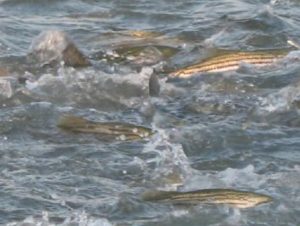
Recent surveys of juvenile striped bass in the Chesapeake Bay watershed yielded mixed results for 2026. Conducted by biologists in Maryland and Virginia, the surveys included counts of juvenile striped bass and other species in waters of the Chesapeake Bay.
Maryland
The Maryland Department of Natural Resources’ (DNR) 2026 juvenile striped bass survey recorded a young-of-year index of 5.5. Although it marks the eighth consecutive year of low spawning success for striped bass, this is the highest index recorded since 2018. The survey tracks the reproductive success of Maryland’s state fish in Chesapeake Bay.
During this annual survey, fisheries biologists sample 22 sites located in four major striped bass spawning areas: the Choptank, Nanticoke, and Potomac rivers, and the upper Chesapeake Bay. Biologists visit each site three times per summer, collecting fish with two sweeps of a 100-foot beach seine net.
The index represents the average number of 3-inch or smaller juvenile striped bass caught in 132 sweeps of the net. The survey, one of the longest-running continuous fish surveys in the United States, has been conducted in Maryland’s Chesapeake Bay since 1954.
This year’s survey captured 723 juvenile striped bass. The highest performing areas were the upper Bay and Choptank River. Although striped bass catches were below average, the fish were more widely distributed than in recent years, indicating suitable habitat throughout the nursery areas. The long-term average index for the survey is currently 10.8, while the index was 4.0 in 2025 and 2.0 in 2024.
Biologists captured nearly 72,000 fish of 61 different species while conducting this year’s Maryland survey. Positive findings from the survey include two important forage species that were documented in abundance during the survey. Young Atlantic menhaden were found in abundance, while Atlantic silversides were found in the highest numbers in over a decade. These species are vital to the ecology of the Bay as a food source for many other species of fish and wildlife.
Another encouraging finding was above-average reproduction of American shad in the Potomac River and upper Chesapeake Bay; however, the survey does not evaluate the larger, adult populations of these species.
Virginia
Preliminary results from an ongoing long-term survey conducted by William & Mary’s Virginia Institute of Marine Science (VIMS) suggest that an average year class of young-of-year striped bass was produced in the Virginia tributaries of the Chesapeake Bay in 2026.
The VIMS Juvenile Striped Bass Seine Survey recorded a mean value of 9.52 fish per seine haul in the Virginia portion of the Chesapeake Bay. The 2026 value is an increase from the 5.12 fish per seine haul recorded in 2025, though both years are similar to the historical average (7.77 fish per seine haul) observed in Virginia tributaries.
The improvement in recruitment observed in 2025 and 2026 is consistent with historically observed patterns: years with below-average recruitment (i.e., 1999, 2002, 2012, 2024) were followed by years with average to above-average recruitment (i.e., 2000, 2003, 2013, 2025).
The VIMS survey team samples fish from 18 index sites in the Rappahannock, York and James River systems. Scientists sample each site five times from mid-June to early September, deploying a 100-foot seine net from the shore.
Captured fish are counted, measured and returned alive to the river. At this time of year, young striped bass usually measure between 1.5 and 4 inches. In 2026, scientists measured 2,648 juvenile striped bass at index sites in Virginia.
Researchers at VIMS & the Batten School of Coastal & Marine Sciences have conducted the Juvenile Striped Bass Seine Survey annually since 1967 for the Virginia Marine Resources Commission and to support coastwide stock assessments for striped bass.
Striped Bass
Striped bass are an important top predator in the Chesapeake Bay ecosystem and a valuable resource for commercial and recreational anglers.
The striped bass population in the Chesapeake Bay has rebounded from historic lows in the late 1970s and early 1980s, after fishing bans were enacted in Delaware, Maryland and Virginia in the mid- to late-1980s.
Since then, the population increased to the point that striped bass in the Bay and elsewhere along the Atlantic Coast were considered recovered.
Years of heavy fishing followed, after which scientists determined that the striped bass population was overfished, and that fishing-related mortality exceeded sustainable levels.
Through the Atlantic States Marine Fisheries Coalition, Maryland and other states that border the Atlantic Ocean have implemented management actions aimed at rebuilding the striped bass spawning stock. Those measures include reductions to catch limits, increased protections for spawning fish, tighter slot limits, and season closures.
Recent population estimates indicate healthy adult populations of striped bass, despite the downturn in juvenile spawning success. A rebuilt adult population should reproduce successfully when conditions like river flow, temperature and food availability are favorable for striped bass eggs and larvae.
Multiple factors affect striped bass spawning success in the Chesapeake Bay. Cold winters and wet springs tend to be beneficial for spawning, and while Maryland experienced a cold winter, the prolonged regional drought and resulting low river flows may have led to unfavorable conditions for striped bass eggs and larvae.
High river flows increase spawning habitat, allow eggs to remain suspended in the water column, and bring larvae closer to food sources.
Other variables, including a shortened spawning period, could also influence spawning success. Recent population estimates indicate healthy adult populations, despite the downturn in juvenile spawning rates.
Low levels of reproduction will likely guide future conservation measures considered by the Atlantic States Marine Fisheries Commission.
Recent consecutive below-average year classes will likely become more apparent among the adult population of striped bass in the coming years, as the juveniles reach maturity.
A benchmark stock assessment for the coastwide population of Atlantic striped bass is underway and expected to complete peer review in spring 2027. The stock assessment will evaluate the condition of striped bass from Maine to North Carolina and inform future management actions.
According to the Atlantic States Marine Fisheries Commission’s (ASMFC) 2024 Atlantic Striped Bass Stock Assessment Update Report, the stock remains overfished but is no longer experiencing overfishing.
Since 2022, multiple measures – including size limits on the recreational fishery, bag limits, gear restrictions and commercial quota reductions – have been implemented to reduce fishing mortality and rebuild the striped bass stock by 2029.
More information about current striped bass management and regulations is available on the Atlantic States Marine Fisheries Commission website.
In the Chesapeake Bay region, striped bass are also known as rockfish. The species is important to both recreational and commercial fishermen.
sources: Maryland Department of Natural Resources, Virginia Institute of Marine Science
Leave a Reply
You must be logged in to post a comment.