In August, the state of Maryland released information about its pollution reduction targets set under the 2014 Chesapeake Bay Watershed Agreement to improve water quality.
Based on the most recent information from the Chesapeake Bay Program’s pollution model, Maryland achieved 100% of its sediment reduction goal, 100% of the phosphorus reduction goal and 99% of the nitrogen reduction goal from 2009 to 2025. The model was updated this year based on data from 2025.
Under the 2014 Chesapeake Bay Watershed Agreement, Maryland also helped achieve goals for tributary-scale oyster restoration, land conservation, fish passage, and public access.
Maryland’s pollution reductions outpaced the broader Bay partnership’s efforts, which met the sediment reduction goal but fell short on meeting the watershed’s overall goals for reducing nitrogen and phosphorus.
Under the newly revised Chesapeake Bay Watershed Agreement, Bay watershed jurisdictions will continue working toward the 2025 pollutant reduction targets until 2030 when the partnership will adopt updated targets—informed by the latest science—to meet by 2040.
By reducing sources of nitrogen, phosphorus, and sediment pollution, investing in watershed-scale habitat improvements, and continuing the state’s legacy of land conservation, Maryland is improving water quality for fish and crabs as well as the industries that depend on the Chesapeake Bay.
Maryland’s tourism economy generates an estimated $3.2 billion in economic activity around the Bay while the state’s robust seafood industry contributes about $600 million annually to the state’s economy.
Maryland Clean Water Targets
In waterways, nitrogen and phosphorus fuel the growth of algal blooms. When these blooms die off and decompose, they remove oxygen from the surrounding waters quicker than it can be replenished, causing “dead zones”—areas devoid of dissolved oxygen that make it difficult for marine life to survive.
Maryland’s watershed implementation plan and climate strategy guide the state’s actions to achieve its Chesapeake Bay pollution reduction targets.
Much of Maryland’s progress has been driven by decades of investment in advanced wastewater treatment systems at municipal wastewater treatment plants and the implementation of agricultural conservation practices such as cover crops, streamside forest buffers, and manure management systems.
As Maryland moves into the next phase of Bay restoration and prepares to meet updated 2040 goals, the challenge will be to protect those gains and address pollution sources that are increasingly difficult to control.
The state plans to continue maintaining and modernizing wastewater infrastructure while working to limit stormwater and agricultural runoff to prepare communities and farmers for changing weather conditions.
Together with programs such as the 5 Million Trees for Maryland initiative, the Whole Watershed Program, and certifying agricultural operations as Leaders in Environmentally Engaged Farming, infrastructure work will help Maryland translate statewide pollution reductions into measurable improvements in local waterways and the Chesapeake Bay.
Habitat Restoration and Land Conservation
As part of the effort to reduce Bay pollutants, Maryland is building on its landmark efforts to conserve land in the watershed and restore oyster populations.
In 2025, Maryland finished work in the Manokin River, marking the completion of all five of the state’s targeted oyster restoration tributaries under the 2014 Watershed Agreement: Harris Creek, Little Choptank, Tred Avon, St. Mary’s and the Manokin.
This effort, part of the largest oyster restoration project in the world, has contributed to a tripling of the adult oyster population in Maryland’s portion of the Bay since 2005, according to the most recent oyster stock assessment. These reefs provide vital habitat for commercially important fish species and naturally filter the water.
Land Conservation: In 2024, Maryland met its state-mandated goal to conserve 30% of its land—approximately 1.85 million acres—six years ahead of the 2030 schedule. Maryland was one of the first states in the country to announce that it met this significant land conservation goal.
Public Access: Maryland has exceeded its goal for connecting residents to the water. Since 2011, the state has opened 652 new public access sites, including boat ramps, kayak launches and fishing piers. That amount is more than double the 2014 Watershed Agreement goal of 300 new public access sites across the entire region.
Tree Canopy: Since 2014, Maryland has planted 10,357 acres of trees, with 1,617 acres added in 2024 alone to bolster community tree canopies. As of the end of 2025, Maryland has planted more than 1.5 million trees through its 5 Million Trees for Maryland planting effort and is on track to meet the five million goal by 2031.
Conowingo Dam Agreement
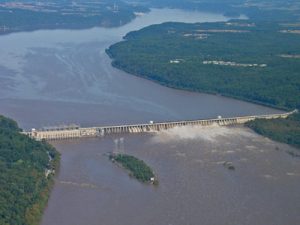
In October 2025, Maryland announced an agreement with Constellation Energy that commits more than $340 million to improve water quality and environmental conditions at the Conowingo Dam.
The agreement will help protect the Chesapeake Bay while allowing the state’s largest source of renewable energy to continue operating. The agreement sets enforceable standards and funds long-term restoration projects in the Bay’s largest tributary.
2025 – 2040 Goals
In December 2025, Governor Moore and the Chesapeake Executive Council approved a revised Chesapeake Bay Watershed Agreement, which streamlined the partnership’s original 10 goals to four, and used the best-available science and latest policy to update these goals with a new target completion date of 2040.
The updated agreement includes 21 revised outcomes that are designed to be clear, measurable and time-bound. Many of these outcomes now align with Maryland’s new strategy of focusing water quality improvement efforts on shallow waterways where most people fish, swim, and paddle.
Maryland is currently working on five waterways across the state for targeted restoration projects through the Whole Watershed Act to benefit habitats, communities and economic opportunities.
Restoration Efforts
Aligning with the revised target of restoring or conserving at least 2,000 additional acres of oyster reef habitats in the Bay, Maryland is already preparing for its next three large-scale oyster restoration projects in Herring Bay, the Nanticoke River and Hoopers Strait.
DNR is also planting oysters at sites in Eastern Bay, which is a multi-use regional project that supports planting in protected sanctuaries, aquaculture lease sites and fishery harvest areas.
The updated Watershed Agreement also includes the partnership’s first commitment to freshwater mussel restoration. It directs the partnership to develop comprehensive mussel conservation plans for 10 tributaries across the watershed.
In Maryland, DNR is designing a new mussel restoration center and identifying waterways that can currently support native mussel populations.
Maryland’s work is being supported by funding through the Conowingo Dam settlement with Constellation secured through negotiations led by the Department of the Environment.
The new agreement’s goals for restoring and enhancing wetlands is also supported by Maryland’s Roots for Resilience initiative that directs federal grant funding to marsh and wetland restoration on the Eastern Shore.
source: Maryland Department of Natural Resources
Leave a Reply
You must be logged in to post a comment.